
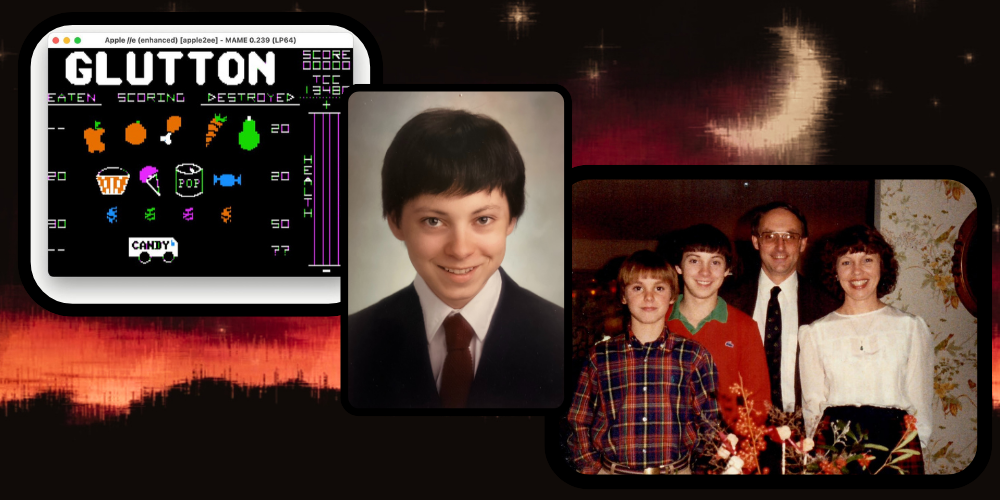
Editor’s Note: This story was written by Alicia Graves, EiC of NeverMore Niche, and first published in Mega Visions Magazine, in 2023. As the magazine is now out of print, we feel that Tracey’s story is too important to be left on a shelf and have republished it, in its entirety here with permission from his family.
There are people who pass through the halls of history and move on too soon to really know the impact they might have had on the world. Sometimes, they are praised as brilliant and remembered for their deeds. Others, no less shining in brilliance, are left on the pages of dusty tomes and in boxes left on closet floors. Tracey Cullinan, the creator of Glutton, is somewhere in between. For the first time, we have the privilege of telling his story in the pages of our magazine. And through his story, we hope that not only will his incredible legacy be preserved, but that our readers take some inspiration from the young man who never gave up, even in the face of death.
Tracey first showed up on my radar in January 2022, after a tweet about his game Glutton, once thought lost, surfaced on Twitter. Made originally for Apple II, the game remained unrecovered and unpublished until a set of rather lucky circumstances came together and created gaming history. But more on that later.
Humble Beginnings, Brilliant Mind
When I first wrote about Tracey and learned a little bit about him, I was struck by the bittersweet journey his life had taken. It was through this, though, that I met his family and friends, and was able to discover the truly incredible story behind the boy.
Born in 1968 to Terrence and Leola Cullinan, Tracey and his younger brother Cory, grew up in Los Altos, California. The family was well known and well liked, Terrence serving as a City Council member and Los Altos’ Mayor from 1985 to 1986. Both parents were Stanford alumni, a tradition that reached throughout the family tree.
Active in the community, the boys played sports as kids and Terrence was often their coach. Leola was also involved in the boys’ lives, focusing on their education. Together, the family was close knit, and the boys thrived in their respective interests.

It was around the time he was in middle school in the early 1980’s, that the family began to see some of Tracey’s brilliance. His aunt, Kathy Merchant, recalled a time when Tracey and his family came to their house, about an hour away in the Bay area. “When they would come over, Tracey had graph paper, and he would be doing all these things with numbers. None of us had any idea what he was doing because there were no home computers,” she said in an interview with Mega Visions. “I now realize it was programming.”
Tracey began working as a salesperson for ComputerLand, a computer shop in the mall not far from his house when he was only 12 years old. He easily learned the ropes, having a natural aptitude for all things computerish. He was very clever, making friends with the employees at the store prior to employment. “I often wrote game programs on the computers, and I bought a disk on which to store the programs. They let me keep the disk at the store,” Tracey said during an interview for “Computer Kids,” a book written in 1984 by George Sullivan. “When customers came into the store, I’d sometimes help out by showing them what a computer could do. They’d be amazed. ‘What’s this nine-year-old kid doing showing me how a computer works?’”
Entrepreneuring Superior Software
His ambition didn’t stop there, though. By the time he was 14, he had started his own business, Superior Software. The company was consultant based, and he contracted his skills out to local businesses, writing unique software programs for them. At that time, computers were still rare, and the software to do simple tasks like invoicing and mailing lists was quite complex. But Tracey had a mind for both coding and business.

“I now know five or six computer languages — BASIC, Pascal, LOGO, plus three machine languages: 6502, the one that’s used on the Apple and Atari and the one I use the most, Z-80. I’m starting to learn 8086, the language for the IBM Personal Computer,” he said. Working with those smaller businesses and his knowledge of computer languages created a pathway for the Atari Youth Advisory Board (AYAB). Someone from the consulting firm he had developed software for was also working with Atari. Tracey’s name came up and he accepted the invitation to join.
The AYAB was a selection of 20 kids from the ages of 14 to 18 across the United States. Many were considered the best and brightest minds in computers at that time, while others were self-proclaimed geeks. “There were real programmers,” John Dickerson, author and media correspondent for CBS News, related during a podcast discussion with Kay Savetz. “Tracey was, you know, a legit software programmer. I mean the most legit I ever got was writing some BBS software that allowed me to have a BBS for a little while,” Dickerson said.

The kids from the AYAB were invited to the Consumer Electronics Show in Chicago. It was a big deal at the time as the event was 18+. The young people showed off the latest in computer technology from Atari, which at that time was something of a rare commodity. “We’ve been giving Atari advice mostly on their home computers,” Tracey said. “Later, I think they’re going to ask us for advice on their video games.”
The Brain Trust
On a roll, Tracey didn’t slow down in the next few years. By 15, he was recognized as a young and rising entrepreneur. People in Silicon Valley and across the nation began to notice the kid from Los Altos. “He was very easy to be around,” Kathy recalled. “He was very humble about what he was doing. He just loved doing it.”
Somehow word got out about his business, and he was interviewed on the “Today” show in 1985 by Jane Pauley. The interview was, in the eyes of the family, a bit awkward as Pauley asked him “Would you call yourself the smartest kid in the class? Are you an exceptional kid by most of your friends’ standards?” True to his aunt’s description, Tracey simply smiled and responded “Well, I don’t know about that […] I’ve got an A average but I’m just a regular guy.”
Tracey was brilliant, make no mistake about that. However, his sense of humility and being a regular guy carried over into his friends’ group. “He and I were always in the smart classes,” said Ted Lee, a close friend of Tracey from middle school and throughout high school. “There was probably four or five of us and we were the smartest kids. They gave us this nickname ‘The Brain Trust.’”
Even “The Brain Trust” kids wanted to have fun, though. The mid 1980’s saw a rise in video game arcades opening across the country and Los Altos was no exception. “We’d ride our bikes home and sometimes stop at this arcade called Central Park,” Ted related during an interview with Mega Visions. “They had all the latest video games. Because adults thought video games were bad for kids, the arcade had this program that you got tokens for every A or B you got. So, it was boon for us smart kids, and we’d get tons of tokens.”

And of course, the love of arcades spilled over into Tracey’s own software designs. Even among his friends, Tracey stood out. “You knew he was good,” Ted remarked. “But it was obvious in a lot of ways that he was really good.”
“Most of us were playing around in Basic, trying to write little games. He was way ahead, programming in 65©02 Assembler, which you had to do to get really good performing games.” Ted said. “I even asked him ‘How do you do that?’ and he explained, even gave me some utilities he had written to use in my games.”
Death Cavern
It was during his high school years that Tracey began making his own games. The first game he created was Death Cavern. “I think that might have been my dad’s influence,” Cory Cullinan, Tracey’s younger brother told me. “It had this fancy artwork, and we found hilarious promotional materials when we were clearing out my mom’s house. I think my dad was involved in getting that paid for.”

While Terrence was the mastermind of marketing for his son’s first game, Tracey was still the brilliant brains behind the game’s design. Unfortunately, despite looking for it, Cory acknowledged that Death Cavern appears to be truly lost. Thankfully, that was not the case with Tracey’s second game Glutton, which has had a journey of its own, including possibly being the first game to incorporate sound bites tied to input actions.
While Tracey was ambitious and successful in his business, Youth Board and software endeavors, he was still incredibly humble. “He was very self-confident and could get along with just about everybody.” Ted said, “He probably would have been the valedictorian. It was unusual because he was super smart but had a great personality and everyone liked him. He just had this ‘have a nice day’ thing.‘” Tracey adopted that as his motto and lived by it. It was so well known that it was immortalized at Los Altos High School.
Even with all the brilliance, he was still a teenage boy. “His favorite TV show was Knight Rider, and he was the envy of the school when he bought his own Trans Am,” Ted said with a laugh. “He liked the Thompson Twins music. I remember it playing a lot at his house. And the only time I saw him uncomfortable was when I convinced him to go on a triple date, but that was for a good reason.”
The Brightest Star Begins to Dim
Tracey was going places. With local and national recognition, and an outlook at going to MIT or Stanford like the rest of his family, he was posed for greatness. And then, because life can be cruel, tragedy struck. It was in his Knight Rider look alike Trans Am that Tracey experienced his first seizer. While driving home one evening, it struck. Ted was with him and able to get the car into the garage.
“Literally at the point of his ascension, it’s almost immediately when his health declined. It was just a couple of months after that interview (on the Today Show) when he had his first seizer,” Cory, Tracey’s younger brother said.
Tracey would suffer from several more over the next few months. The Cullinan’s sought medical advice. The diagnosis was grim- Tracey had a cancerous brain tumor. He was only 16. With a life stretched out before him suddenly in question, Tracey still maintained his humility. “The way he handled it was very graceful,” Cory told me. “My dad was very focused on how unfair this was, how tragic. And I can understand that now as a parent. But the maturity with which my brother conducted himself through all of that was pretty remarkable.”
“I remember thinking,” Cory continued, “’This is why he’s that way- because he’s already doing what he wants to do…When he got sick it wasn’t like ‘oh now I want to write this computer game’ or ‘oh now I want hang out’ or ‘oh now I want to do this.’ He was already doing it.”
“It really stuck with me that life is short and if you live by your values, when it ends, it’s going to be ok,” he said. Tracey apparently found peace, even acceptance in his possible death. “That’s not at all to say he was happy about dying. But he wasn’t flailing around wishing about all the things he wished he had done,” Cory insisted.

The boys still tried to have some sense of normality, going to sporting events and amusement parks with their family. However, Tracey’s health continued to decline. Tracey’s father didn’t give up and through research, found a doctor who thought he could remove the tumor surgically. The surgery was attempted and failed. Tracey underwent chemo to slow the spread, but it was unsuccessful, and he was given less than a year to live.
In The End
It was during his final months that he received visits from Steve Jobs, of Apple. At the time, Steve was the head of NEX. Impressed with Tracey’s accomplishments, he spent time with Tracey, showing a compassionate side that would surprise most. “I remember when he came to our house,” Cory related, “there was no press, no fanfare. I never heard of a story about it. He was just doing it because he had heard about this kid, this programmer with cancer and he cared.” Jobs took both boys for a visit to NEX, taking great care to converse with Tracey about all of the inner working and technological advances being made there.
It became obvious that Tracey had touched Jobs’ heart. “Tracey was in a home hospital bed at that time because he couldn’t walk, and Steve spent a lot of time, not just like 15 minutes. He came into the kitchen one day and my mom and I were in there. And he implored my mother for like five minutes, to give my brother 3,000 calories a day of carrot juice because he thought it might cure his cancer,” Cory recalled.
Despite every effort, Tracey’s cancer grew to the point he was completely immobilized. But the community around him continued to keep Tracey in their thoughts. His friends, including Ted, were still regulars at his house. He was accepted defacto into Stanford. He would never step foot on the campus.
Creating Ripples
Tracey died just after he had turned 18, in 1986.
The family had a tough time coming to grips with Tracey’s death. Sadly, his father, who had always found solutions to most of his problems, was unable to cope with the loss of his eldest son and turned to alcoholism. He took his own life about a year after Tracey’s death.
Tracey’s mom eventually remarried and Cory graduated from Los Altos high school before heading off the Stanford as well, where he met his wife. Ironically, Cory said he sees a lot of Tracey’s spirit in her.
Tracey’s life created ripples far beyond his death. Cory is now a Grammy award winning composer, music teacher, musician and father. “I just decided I’m going to have an unusual career and try to do something good, have a little bit of an impact,” he said. Kathy, his aunt, who became like a second mom to Cory after Tracey and his father’s deaths, is heavily involved in community outreach for disabled adults. One such program involves video games.
And Tracey’s legacy continues in mysterious ways. Whether it is fate or happenstance, circumstances came together to deliver Tracey’s second game to the modern-day gamer.
Finding History
Glutton was once thought as lost for good, just like Death Cavern. Kay Savetz, who has been involved in chronicling the AYAB and video game preservation, through conversations with Cory and Leona, found out about Glutton. After asking if Cory knew where the game was, Kay had to wait a few years before it was actually found. In the meantime, Leona developed dementia and had to retired to an assisted care home. She has since passed away.
While cleaning out their old house, Kathy and Cory specifically went searching for the floppy Apple II disk of Glutton. They had searched everywhere, and were just about to give up, when Cory dug into the closet of his old room. “It was the third night we were there at about 10:50 pm and Cory found it, on this storage shelf,” Kathy told me. “It was definitely an exciting moment.” It is also the only hard copy of the game.


Neither knew if it was playable or not without a computer to try it on. Cory sent it to Kay a few months later, unaware that he had a historical gem. And the process of finding out if Glutton could be played began. “I put the disk into the Applesauce floppy diskette controller,” Kay said. “And it looked like absolute garbage. It just didn’t look right.”
Kay tried another reader, took the floppy disk media out of its sleeve, cleaned it and popped it into a donor sleeve. Again, no dice. “So, I sent it to John Morris, who made the Applesause floppy disk controller. And he said, ‘this isn’t a disk that’s gone back, it’s just protected.’”
Yes, Tracey had encrypted his own game. Most likely as Cory explained, since the game had been rejected by various publishing companies, Tracey wanted to ensure that no one could copy the data and sell it later without his consent. “Thousands of commercially produced programs were copyright protected,” Kay explained. “But that this kid did it himself, for a program that was not actually released, is amazing.”
And it worked beautifully. Once Kay and John understood that the game could be recovered, the disk went to 4 a.m., the “preeminent copy protector of Apple II software. “Twenty minutes later, I get a screenshot from him of the game up and running,” said Kay. “He cracked Tracey’s code and with permission from everyone involved, uploaded it to the archive where everyone can play it.”
Tracey’s Legacy
While Tracey and his family’s story is one that is marred in tragedy, there is a lot of good to pull from it. Despite the odds, Tracey lived his short life with purpose, even after he knew he was going to die. Cory and Kathy have both honored his legacy by living their lives to the fullest and enriching others along the way. And Glutton, the little game that could, found a way to survive all these years and is now available to be played by everyone with an internet browser. The Cullinan’s are a beautiful example of what hope, and preservation looks like. It is their hope, and mine as well, that anyone who reads this story, will take to heart Tracey’s life, and remember his motto: “Have a Nice Day.”
Glutton can be downloaded or played in browser through archive.org.
We honor Tracey and his never-ending spirit each year through our Tracey Cullinan Award, given to two games who demonstrate the drive to not only improve the video game industry, but also the world as a whole. This award is presented by his family during the NeverMore Awards.
Leave a Reply