
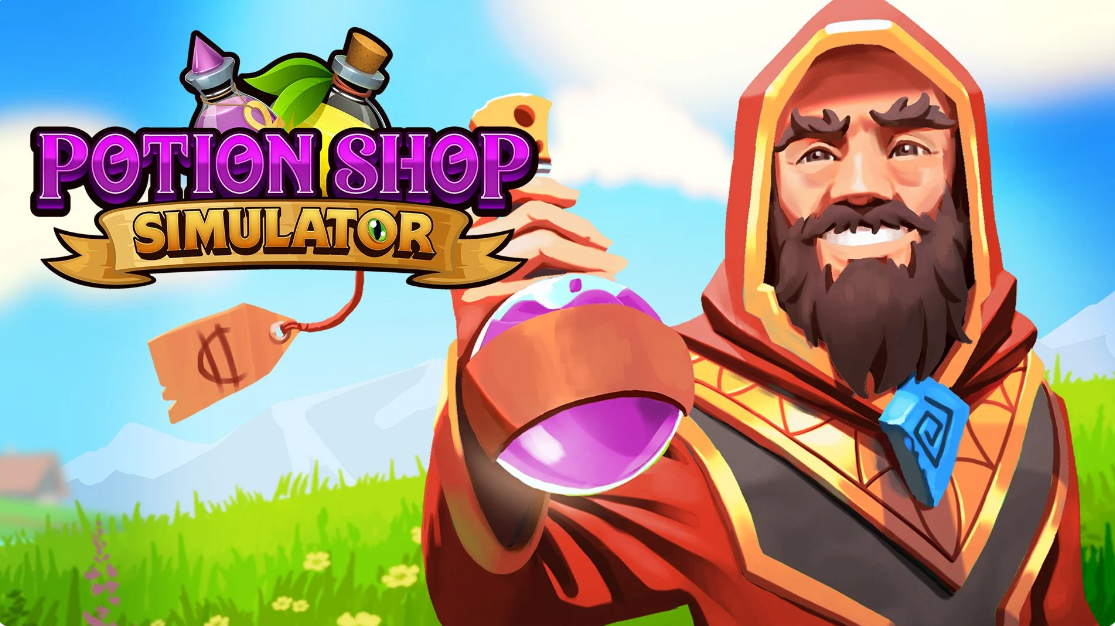
Potion Shop Simulator
Pros
Addicting Gameplay Loop
Consistent Upgrades
Charming World Design
Cons
Occassionally Lags
Quest log doesn't include most quests
Customers can be hard to please
Congratulations! After searching for a potion master position, one has finally opened up! Granted, it’s because the previous potion master mysteriously disappeared. But thankfully, that’s none of your business!
In Potion Shop Simulator, you run your very own startup potion shop in a charming medieval village. Not only will you gather ingredients, brew potions, and sell them to your monstrous customers, but pick up quests along the way. Potion Shop Simulator has a multiplayer option for up to three players but is also enjoyable as a solo experience. It is developed and published by Pebbles Games, with Bird Pals also being credited as a developer.
The Ingredients
A Potion Master can’t brew without ingredients in the cauldron. Your guide, a dragon named Tim, will show you spots where two types of ingredients grow. At first, you’ll need to forage for ingredients. But you can start growing plants in your shop early on into the game, giving you a consistent supply of ingredients.

The ingredients in Potion Shop Simulator have qualities based on the Greek elements: Water, Earth, Fire, and Air. (Then, everything changed when the Fire Nation Attacked.) An ingredient might be strong in just one element, or consist of multiple elements.
Now, the ingredients’ elements are not unchanging. After drying an ingredient on the drying rack, use your mortar and pestle to grind the ingredient into a powder. Powdered ingredients have an increased potency, and they’re a lifesaver when brewing potions.
Get to Brewin’
Why do the ingredients’ elements matter? Well, familiarizing yourself with the elements is crucial to the art of brewing potions. It sounds complicated at first, but the system is easy to learn and fun once it becomes complex.
You see, each potion has a different ratio of elements. For example, the Goblin Gut Soother has the ratio of 1 Fire and 2 Air. A simple way to make this potion is to use one ingredient with 1 Fire and two ingredients with 1 Air.

In order to make a higher quality potion, the element ratio must be perfect, or at least close to it. You can make a potion with an imbalanced ratio, but the quality will be so poor that it won’t sell for much. This could be a way to save on ingredients if you want to be the fast fashion of potion shops.
For my fellow perfectionists out there, beware: you can’t just throw ingredients into the cauldron until the ratio is perfect. The starter cauldron has a maximum of 4 ingredients per potion. Potion making is, after all, an art that requires precision and delicacy.
Once you input the ingredients for the potion you want (a parchment above the cauldron shows you what the ratio will produce), stir the potion. Then, wait for it to brew. But instead of lollygagging while you wait, use this time to harvest your plants, water them, and set ingredients on the drying rack! Hurrah for multitasking!
After your potion has brewed, bottle it up and it’s ready to go! But if you ask me, it’s worth the little extra bit of time to throw it in the distiller. Once it simmers in there for a bit, the quality – not to mention the price – is better.
The Power of Gnomes

The novelty of stirring the potion and grinding ingredients is fun, but once you’re established enough to attempt keeping your shop open while brewing new potions, these mini-games become a bit of a slog. Thankfully, right around the slog point is when the Gnomes become affordable!
Gnomes are little statue assistants that help you with particular tasks. You can have a stirring Gnome, a grinding Gnome, a cashier Gnome, and more. My favorite part of simulators and tycoons is setting up automation ASAP (hoorah for the industrial revolution!), so this is when the game got really fun for me.
The Customers are Always…
Remember, a business isn’t just cozy potion making and gnome-cuddling. As a Potion Master, you must contend with the great beast of the business world: customer service.
The customers are divided into several different categories. Each category requires different potions, sizes, and quality. So, you can’t stock up on one kind of potion to get by; you need variety if you’re to grow your business. Potion selling is a risky business, and if a customer walks away unsatisfied, you’ll lose reputation.

Oh, by the way: you have to increase your reputation in order to level up your shop. You can also level up your shop by increasing your decoration score, which you can do by (you guessed it) buying more decorations. The higher level your shop is, the more refined your customers will be. The newer customers will be picky, but they’ll pay more.
Losing reputation because of the higher-level customers was definitely my least favorite part of the game. Sure, it offered a challenge. I couldn’t just perpetually keep my shop open while running around picking flowers. When brewing potions, I would have to consistently pop downstairs to see what was still in stock, and I never had enough time to restock without closing the store entirely.
This made me not want to open my store until I was fully prepared with all my potions, and I couldn’t always make my potions without money to buy extra ingredients. And how do you make money? By opening the store, of course. But I couldn’t open the store until I was fully prepared, or else I’d lose reputation. Do you see what my issue is?
There’s also a barter system in the game. I’m not going to lie: I tried bartering twice, somehow got less money than the original price, and never used it again.
Free Labor
As you can probably tell, the bulk of the gameplay is brewing potions and selling them. The job of a potion master includes a lot of grinding and repetition, but if that sounds like more work than fun, not to worry. The villagers are eager to take advantage of the new Potion Master. Soon, you’ll have enough quests to distract you from your 9-5.
A notable request is what I’d consider the “main quest,” at least in the beginning. Remember earlier when I said that the missing Potion Master was none of your business? Yeah, I lied. Unfortunately, the potion shop vacancy that you filled was not because your predecessor retired. The Potion Master who previously owned the shop mysteriously vanished, and his former assistant asks you to investigate.

While this sounds exciting, this quest can be summed up by the following:
- Approach NPC
- NPC needs a thing before they will talk
- Make/find the thing
- Give NPC the thing
- NPC pays for thing with information. The information is “go talk to this other person.”
- Walk away somehow poorer than before.
- Approach the next NPC. Rinse and repeat.
I get that simulator games aren’t usually narrative-first, but man. A dude is missing, and all these people can think about is taking advantage of the poor little potion master. And they just have to get free potions before they’ll talk!
In all honesty, there are not many ways to write a simulator game task that’s not just a craft or fetch quest. But I wish the quest incentive wasn’t information about a dude that I don’t care about. If the villagers would give me extra ingredients, supplies, or cold hard cash, I might be a little more eager to brew for free.
Hello Neighbor!
All in all, I’m glad that these quests are in the game. They effectively make the world feel less “empty.” You might walk down a street that’s lonesome one day, but the next, your neighbor is on their porch with an exclamation point over their head. Rather than shopkeepers who stand mindlessly at their counter day and night, they’re shopkeepers with personalities and desires… who also happen to stand mindlessly at their counter day and night.

The quests also introduce you to new aspects of potion making. I’d often get potion requests, only to find myself realizing that I’d never heard of that potion before, even after several hours in the game.
One downside to these quests: I noticed that the majority of them aren’t noted in the quest log. And there’s no way I’m going to remember that the lizard creature next door to the tavern wants a medium-sized Basilisk’s Gaze potion with a side of fries.
Final Thoughts
Overall, Potion Shop Simulator has a lot more depth than I was expecting. Game progression is consistent enough to keep my motivation up, even if my customers are always there to shoot it right back down again.
Despite my frustration with customer service, this game has occupied all of my free time since I started playing it. The gameplay loop of potion making, shop upkeep, and quest completion is satisfying and addicting. And the vibe of the game, with its beautiful lighting and detailed world, is just flat out charming.

If you’re a fan of simulator games, or you want to try one with a fantasy flair, check out Potion Shop Simulator on Steam for $16.99!


Leave a Reply