
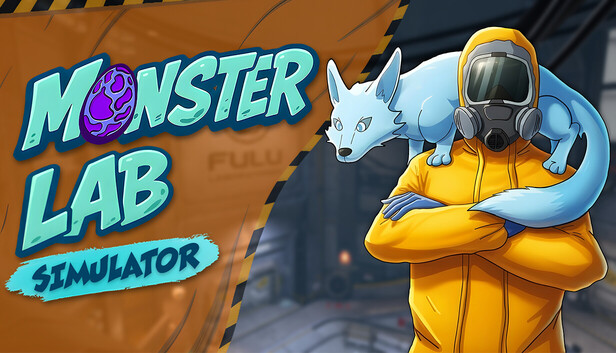
Monster Lab Simulator
Scores and Opinions reflect the February 2026 Early Access Build
Pros
Fun Core Loop
Clear Systems
Interesting Premise
Lots of Critters
Cons
Early Plateau
Little System Depth
Lack of End Goal
Accessibility Issues
Monster Lab Simulator is a game that asks some really fun questions; “if I combine these injection serums with this egg, and then fuse the result with another creature, can I create something more valuable than what I started with?” being my favorite so far.
Monster Lab Sim is the the debut Steam release from Round3 Studios, previously known for their mobile titles, and is published by KikiGames, a publisher with a backlog of similar simulation titles.
Many aspects of this Early Access build already feel surprisingly polished and functionally sound. However, the game’s thematic and gameplay execution still seem uncertain about what direction it wants to fully commit to. The longer I played, the more that lack of a clear game identity defined my experience despite the game being overall structurally sound.
Before we get started though, a small note:
I played this Windows-exclusive Early Access build on Fedora Linux through Proton GE. So keep that in mind when I discuss issues I had on a technical side. Although not all issues with the game are platform-exclusive, I do just want to make that clear before continuing.
But with that out of the way, let’s get to—
Opening the Doors
The onboarding is direct and unambiguous. Giant locked doors frame early progression, tutorials walk you through your first few interactions, and within minutes the game communicates its core loop:

Buy eggs → Inject serum → Hatch creature → Sell creature for profit → Repeat.
It is immediately readable, and to the game’s credit, never mechanically confusing. You move between machines, manage serum inputs for unique critters, wait for eggs to hatch, and gradually expand your lab as you sell off your critters. The feedback loop is clean enough that you settle into its rhythm almost automatically.

Minute to minute, the experience is serviceable. It is the kind of simulator that pairs comfortably with a podcast or second monitor video, not because it lacks engagement, but because its systems operate within a predictable bandwidth. Many management games thrive in that space, and there is nothing inherently wrong with that design philosophy. Monster Lab Simulator’s use of time-gating for certain interactions does lean a little harder into it than most games do, but that is neither here nor there.
New mechanics appear the further you progress. Extracting offers more serums to inject into eggs. Fusions unlock evolutions and synthesizing. Combat introduces automated arena battles that give you the ability to win prizes, and so on. On paper, these additions suggest escalation; in practice, they feel more adjacent than transformative of the main gameplay loop.

Combat is the poster child of this feeling for me. It’s an autobattling experience where you slot in some poor critters and send them into an arena to fight other critters while you watch. Victories reward tickets that you spend on a gambling machine for rarer items to expand your catalogue. Fun? Sure, but tonally it just doesn’t quite fit with the rest of the game.
It feels less like a strategic side system that meaningfully enhances your laboratory and more like something slotted in to occupy space while other systems stretch themselves thin. I feel this way about several of the side systems of the game, which is a shame, because I genuinely like the idea of them being here.
Everything does work in its own silo, but because those systems rarely compound or pressure one another, the loop begins to feel familiar sooner than it should.
Surface Level Science
Most of Monster Lab Simulator’s mechanics reveal their full logic early, within the first two to three hours. Once you understand how the systems broadly function, there is relatively little left to decode. Sales requirements do not become more particular, and systems rarely begin to overlap in ways that create new pressures or decisions.
Simplicity is not inherently a flaw; clarity is one of the game’s strengths after all. The issue is that simplicity never develops into layered complexity. You can min-max, but the game never demands it. You can design creatures with intentional goals for their use, yet the difference between careful planning and casual assembly often feels marginal in the larger scheme of things.

The gambling machine illustrates this well. It is conceptually amusing, but it does not meaningfully complicate the economy or introduce long-term considerations. It functions more like seasoning than substance, and when the meat of the game stays largely the same, well… there are only so many ways you can season the steak.

This lack of meaningful depth in the game leads to an early plateau. Around the ten-hour mark, the experience stabilizes into repetition. For a simulator, that can be difficult to ignore.
Most games in the genre either provide a clear end goal to anchor repetition, or they layer in enough systemic complexity to avoid stagnation. In the case of Monster Lab Simulator, at least in it’s current state, it seems to be neither.
Much of this is understandable within an Early Access framework, particularly given that I was playing a pre-Early Access build. Structural goals can be clarified, system interdependencies can deepen, but as it stands, the game feels less like a cohesive laboratory ecosystem and more like a collection of unfinished experiments.
Flawed Fabrication
Outside of the core mechanics, there are smaller but noticeable issues on the accessibility and UI fronts.
The interface is visually clean, but not always comfortable to use. Tablet menus rely on light fonts on light backgrounds that are technically legible yet difficult to parse at a glance. In a management-focused game where you are constantly checking inventories and upgrades, readability matters. At present, there are no scalable UI options or alternative color settings, which limits accessibility for people with worse vision than I.

Control rebinding is also absent. For a simulator designed for extended play sessions, that feels like a baseline feature rather than a luxury. Comfort toggles do exist, but some are categorized in unintuitive ways. Camera bobbing, for example, is labeled as “Wobble” and tucked under Controls instead of Visuals, which makes it easy to overlook if you do not already know it is there.
On a more tactile level, interactions can feel slightly fussy. Selling creatures or placing items sometimes requires more precision than the game’s tone suggests. I would’ve loved more fun ways to do some tasks. Yeeting balls into the sell pipe, stacking machines on each other, just more goofy stuff to up efficiency and chaos. It is a small thing, but in a loop built on repetition, small friction accumulates.

On Linux through Proton, I encountered consistent freezing when alt-tabbing, occasional audio sliders failing to apply without a restart, and intermittent clipping when purchasing large batches of items, which could make them difficult to pick up. I cannot reliably determine which of these are platform-specific and which are broader issues, but they are worth noting.
Even with those caveats, the overall build is more polished than many Early Access releases in recent years. The technical and performance side I have little issue with.
My primary concerns lie in direction and systemic depth, not stability.

An Experiment Worth Continuing
I enjoyed Monster Lab Simulator. I invested nearly twenty hours without forcing myself to do so, which speaks to the strength of its core loop and the appeal of its premise.
What it lacks is not functionality, fun, or even good system ideas. It just lacks direction.
If the game wants to lean into creature raising, it could introduce breeding systems, generational traits, and management decisions that force players to balance profit with sustainability.
Creatures could develop identities beyond stat numbers. It could function more like a creature-raising sim in the vein of certain monster-catching titles that I will not name in order to avoid an unexpected visit by their menagerie of ninjas. You could add more to the battle system (which they say they plan to do), maybe feeding or grooming systems?
The game could embrace the mad scientist fantasy more aggressively, which I think is its unique trait. It could introduce unstable mutations, experimental failures, ethical trade-offs, and economic risk that genuinely destabilizes the loop. Profit could come at a cost beyond time investment. Balancing mad-scientist excess against mechanical sustainability could be genuinely compelling if it were more present in the system design.
Final Thoughts
Right now, Monster Lab Simulator occupies a middle space between those identities. That ambiguity works in Early Access, but for a full release, the game will need to commit to a clearer thesis about what kind of laboratory it wants to simulate.
There is something compelling here. The foundation is solid. The systems function. The concept has room to grow.
The question is not whether the experiment works. It’s what the experiment is trying to prove. That is something I look forward to seeing clarified as Early Access continues.
Monster Lab Simulator is created by Round3 Studios, and published by KikiGames.
It was released February 20206 on Steam into Early Access.
Game was played and reviewed on Fedora KDE Linux. NeverMore Niche received a review key through KeyMailer.
Leave a Reply