
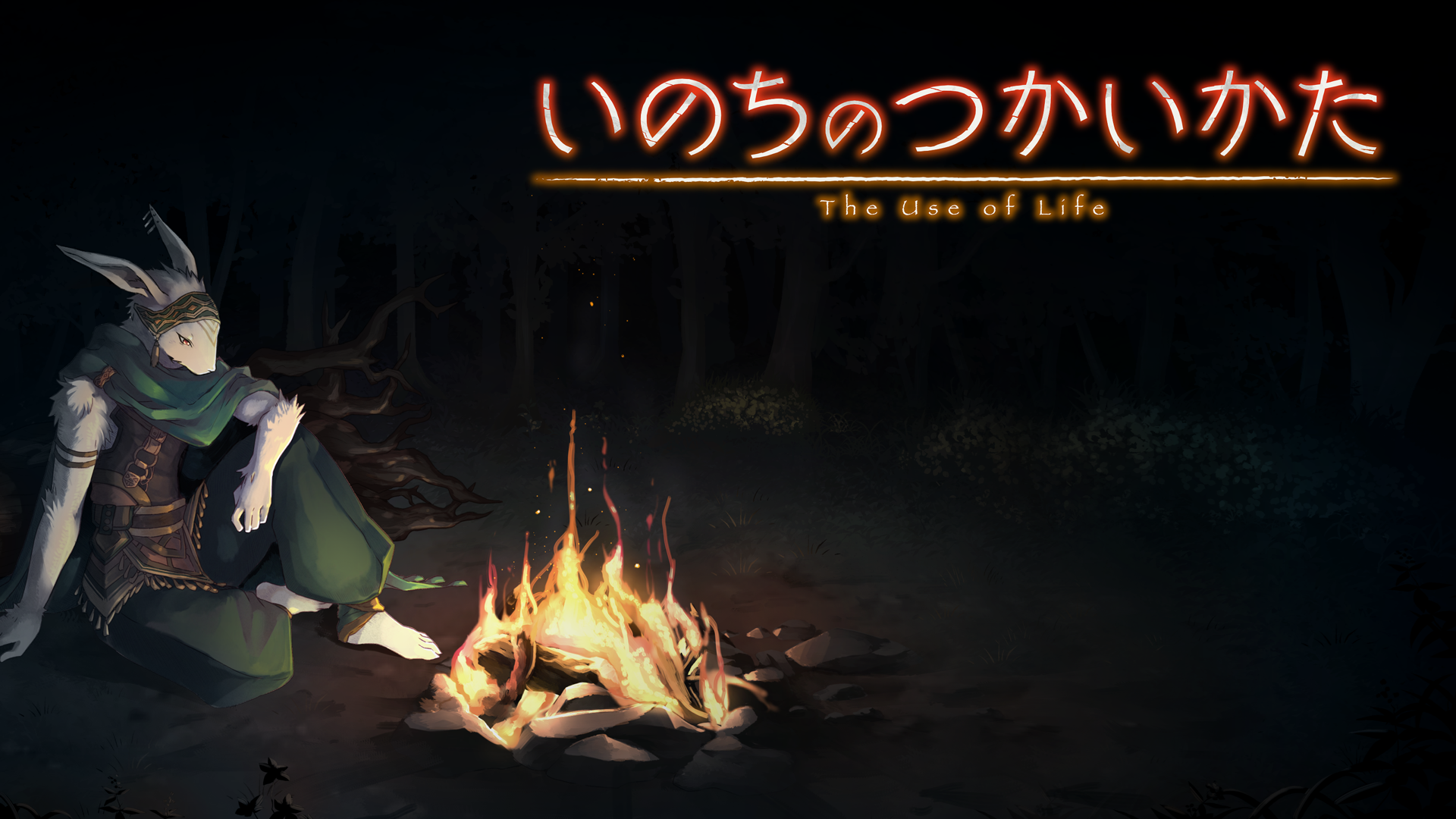
The Use of Life
Pros
Cool Concept
Impressive Ambition
Strong Thematic Core
Engaging Gameplay Loop
Cons
Accessibility Problems
Lacks Overall Depth
Can Be Difficult
Imagine you live in a quiet, peaceful village. You grow up among a small community of familiar faces, a kind family, a loving partner, everything perfectly how it should be.
Then one day, without warning, all of it is ripped from you by a force you cannot control. Your home burns to the ground. Your family is killed, your friends are gone. Yet by some cruel twist of fate, you survive, with no one to blame, but people to avenge. Would you let rage, anger, and vitriol consume you? Or would you be able to recover from such a tragedy?
The Use of Life asks you that question and gives you both the power and the means to find an answer.
This is the debut project from solo developer だらねこげーむず/Daraneko Games, published by PLAYISM. A gamebook-style multi-ending JRPG that draws from tabletop sensibilities, choose-your-own-adventure narrative structure, and a combat system blending turn-based strategy with real-time play. It arrived in full release November 26th, 2025, after three and a half years in Early Access and over six total years of development.
For a solo-developed RPG, it is an impressively realized package. Most of what it attempts, it handles with confidence and precision. While it does falter in some regards, it overall does very well in telling an engaging narrative through unique (if difficulty) gameplay and game-defining choice and consequence.
Before we get into the game however, I must divulge. I played this Windows-exclusive title on Fedora Linux through Proton GE. No native Linux build exists, so keep that in mind for any technical notes later on. Technical spoiler warning, it runs flawlessly.
With that, let’s discuss The Use of Life.
Of Forking Paths and Flickering Flames
To start, I want to cover what I think defines the entire experience: the Flame of Life and Flame of Power system. Everything in this game orbits it, and everything that follows in this review stems from how you feel about it, and how you influence Goshe (our rabbitfolk protagonist) along it’s axis.
As you make choices throughout the game, these two competing values shift in response. Lean toward self-preservation, compassion, and caution, and your attachment to life grows. Lean toward vengeance, aggression, and dominance, and your attachment to power takes over. These are not cosmetic values. They determine which routes open to you, which locations you visit, which characters you encounter, and ultimately which of the game’s multiple endings you achieve the criteria for.

To the game’s credit, this system works. It is tried and tested as a design philosophy, and The Use of Life implements it with genuine commitment. Entire acts change depending on the direction you take. Runs can look and feel meaningfully different from one another, and for a solo-developed title, the sheer volume of branching content is commendable.
The game also takes a stance I appreciate: there are no “good” or “bad” endings. Each conclusion is framed as the natural result of how you chose to live, which fits the thematic identity the game is going for. While I wouldn’t say the story is particularly deep though, I do think the narrative(s) that you are told through the game through it’s themes (as well as it’s writing) do perfectly fine. Not standouts by a major point, but pretty solid nonetheless.
Where the story-sided aspects falter is not in their breadth, but in their depth.
The choices you make successfully change where the story goes. They are less successful at changing what the story is saying. The morality system functions well as a routing mechanism, directing you down paths that feel distinct on a structural level. But thematically, those paths rarely challenge the player to sit with the weight of what they’ve chosen. You see the consequences play out, but the game seldom lingers on them long enough for them to resonate beyond the moment.
If I were to describe The Use of Life‘s approach to choice and theme, I would compare it to a wildfire. It covers an impressive amount of ground. It is bright, it is attention-grabbing, and at its best it is genuinely spectacular to watch unfold. But fire only ever burns across the surface. It doesn’t dig. It does not put down roots. And once it passes, what it leaves behind is not new growth, but flat ground.

The game raises interesting thematic signposts along the way. Questions about identity, about what tragedy does to a person, about whether vengeance is worth the cost of carrying it out. But it treats these more as scenery rather than destinations. They appear, they register, and then the path moves on. For a game whose entire identity is built around the question of what a life is for, I found myself wishing it would slow down long enough to actually sit in that question rather than simply pointing at it as you walk past.
None of this makes the thematic ideas presented worse, it just makes them broad. And for many players, that breadth will be more than enough. Multiple playthroughs will yield meaningfully different experiences, and the sense that your choices matter on a structural level is real. But for me, the difference between a good morality system and a great one is whether it changes how you think, not just where you go.
That being said, it’s pretty damn good either way, and one that I will be recommending to RPG fans of every spade, since it genuinely has a lot of heart despite a few hiccups.
A Worn Blade is a Good Blade
The Use of Life‘s combat is where the game feels the most confident in itself.

Each encounter operates on a three-action turn-based system. At the start of every turn, you select three commands from your available pool of attacks, spells, items, and defensive options, and then execute them in sequence against your opponent’s own set of three. It is a simple framework that the game builds on effectively. Parrying, dodging, and blocking are all handled through real-time QTE inputs during the enemy’s turns, requiring you to read attack patterns, time your reactions, and learn enemy behavior over repeated encounters. The result is a combat system that demands both strategic planning and mechanical execution, and when both click, it feels genuinely rewarding.
The class system supports this well. Fighter, Samurai, Mage, and Sorcerer each offer distinct playstyles, and the game allows you to mix investment across them, eventually unlocking advanced classes that build on those foundations. There is a satisfying amount of build variety here, and the game does a commendable job of teaching you its systems diegetically.


Items, gear, and consumables all feel purposeful. Weapons and armors meaningfully shift how you approach, and the consumable economy encourages you to prepare before difficult fights. For a solo-developed title, the amount of mechanical content here is impressive, and most of it works.
Where the cracks begin to show is in longevity.
Jack of Some, Master of None

Once you internalize the core systems, which happens somewhere around the midpoint of your first playthrough, the tactical ceiling becomes increasingly visible. Enemy encounters begin to feel like endurance tests rather than fun mechanical puzzles. Many enemies have large enough health pools that fights become less about what you do and more about how long you can perfectly dodge without making a mistake.
The depth is there theoretically, but in practice, mastering the parry and dodge timing will carry you through most encounters. Conditions exist but rarely feel impactful enough to build around outside of a handful of fights. HP and MP as stats feel strangely vestigial, to the point where the game could have replaced them with a hit-count system and lost very little mechanically.
I want to be clear that this is not a complaint about difficulty. The game is challenging in a way that I think will push most players in a satisfying direction, and the boss encounters in particular demand genuine engagement. It is more that the systems, as strong as they are out of the gate, do not evolve as much as I would have liked over the course of a full playthrough. On replays, the novelty of learning the systems is no longer there to carry the experience.
Outside of combat, exploration operates as a point-and-click style adventure. You navigate between locations, choose branching paths, and encounter events along the way. Some of these events feature D100-style dice rolls reminiscent of tabletop RPGs. These moments work well enough as connective tissue between story beats and combat encounters, though they rarely feel integral to the experience. On a first playthrough, the exploration is interesting enough to keep you engaged. On subsequent runs, the seams show more clearly.

But honestly, if I were to hand this section a single takeaway, it would be this: I do not think I would change much. I wish the systems were expanded on, certainly. I wish the depth matched the breadth. But for what is here, built by a single developer, the gameplay is the strongest pillar of The Use of Life, and it stays that way from start to finish.
To follow up on the technical spoiler warning from earlier, I played the game on Fedora Linux through Proton GE despite no native Linux build existing. I experienced zero bugs, zero crashes, and zero startup issues across my entire playtime. It ran flawlessly. I expect the Windows experience is just as smooth, if not better.
Ink, Illustration, and Ill-Accessibility
The Use of Life has a strong visual identity. It is not radically unconventional for the genre, but it is cohesive and charming in a way that serves the game well.
The art style leans into a gritty, manga-adjacent aesthetic that fits the tone of the narrative without overcommitting to any one visual tradition. Character designs are expressive and distinct across the cast, and boss designs in particular stand out as highlights. There is a confidence to how the game presents its more dramatic moments through full CG illustrations that punctuate key scenes, and these consistently punch above what you might expect from a solo-developed title. That could just be my old furry roots coming back out, but hey, I never said I was un-biased.


Between those peaks, the standard presentation is more modest. Exploration and general gameplay lean on a simpler but still hand-drawn approach, and some sections can feel visually plain by comparison, but it does the job well enough.
The gamebook narration style deserves mention here as well. The way The Use of Life delivers its story through text-driven, adventure-book framing gives the entire experience a distinct personality. It plays a good deal like a point-and-click game or a well-written visual novel. Nothing overly surprising for the project, but solid nonetheless, and I mean… I never said I was un-biased! (what do you mean I already made that joke?)
The music is strong. It is clearly well-considered, with tracks that support the tone of each moment without overpowering them. It is not a soundtrack that I find myself seeking out independently, but within the context of the game, it does exactly what it needs to do. Commendable work that earns its place in the experience without demanding attention away from it.
Accessibility is a little weird. Clearly the game is made for Controller, but I didn’t have any major issues with the implementation of the Keyboard variant controls once I understood them (say goodbye to your mouse!) but I do find that this game has a fair few of these issues. There are too many small things to reasonably add up in this review and not waste your time, but I would definitely try out the demo and make sure you can stand the obtuseness of the controls, otherwise you might be a bit disjointed in the game-feel like I was.
Overall, the presentation of The Use of Life does what good presentation should. It gets out of its own way when it needs to, and shows up when it matters most.

Using Life
Maybe your answer to facing tragedy is to let that vitriol fuel a path of vengeance, cutting down everything in your way until there is nothing left to avenge. Perhaps it’s to seek out the people who still need you, to find something worth protecting even when the world has given you every reason not to. Often, it is something in between, a quieter compromise that nobody writes stories about but most people actually live.
The Use of Life gives you all of those options, and to its credit, it does not tell you which one is correct.
This is an incredibly solid RPG. The developer spent over six years building something with genuine heart, real mechanical ambition, and a commitment to player choice that most studios with ten times the resources do not bother trying. It is a good deal, for its asking price. On sale, it is a steal. Multiple endings, meaningfully different routes, and enough content across playthroughs to justify the investment many times over. For RPG fans looking for something with teeth and personality, this is worth your attention. I genuinely wish it got more of it.
I do think there are areas where the game could have been handled with more care. The thematic depth I wanted is not quite there. The combat systems, while strong, plateau earlier than I would have liked. Some aspects of the presentation are uneven. These are real criticisms, and I do not want to dismiss them entirely.
But I am also being nitpicky for the scale of this project. One person made this game. And when I hold that knowledge alongside the issues I have, they become very easy to look past. The ambition alone is commendable. The execution is far better than it had any right to be.
The Use of Life does not ask you to solve its question. It does not pretend to have a definitive answer. It simply asks you to sit with it long enough to realize the question was always worth asking.
And for what it is, that is more than enough.
The Use of Life is created by だらねこげーむず/Daraneko Games, and published by PLAYISM.
It was released November 2025 on Steam.
Game was played and reviewed on Fedora KDE Linux.
Leave a Reply