
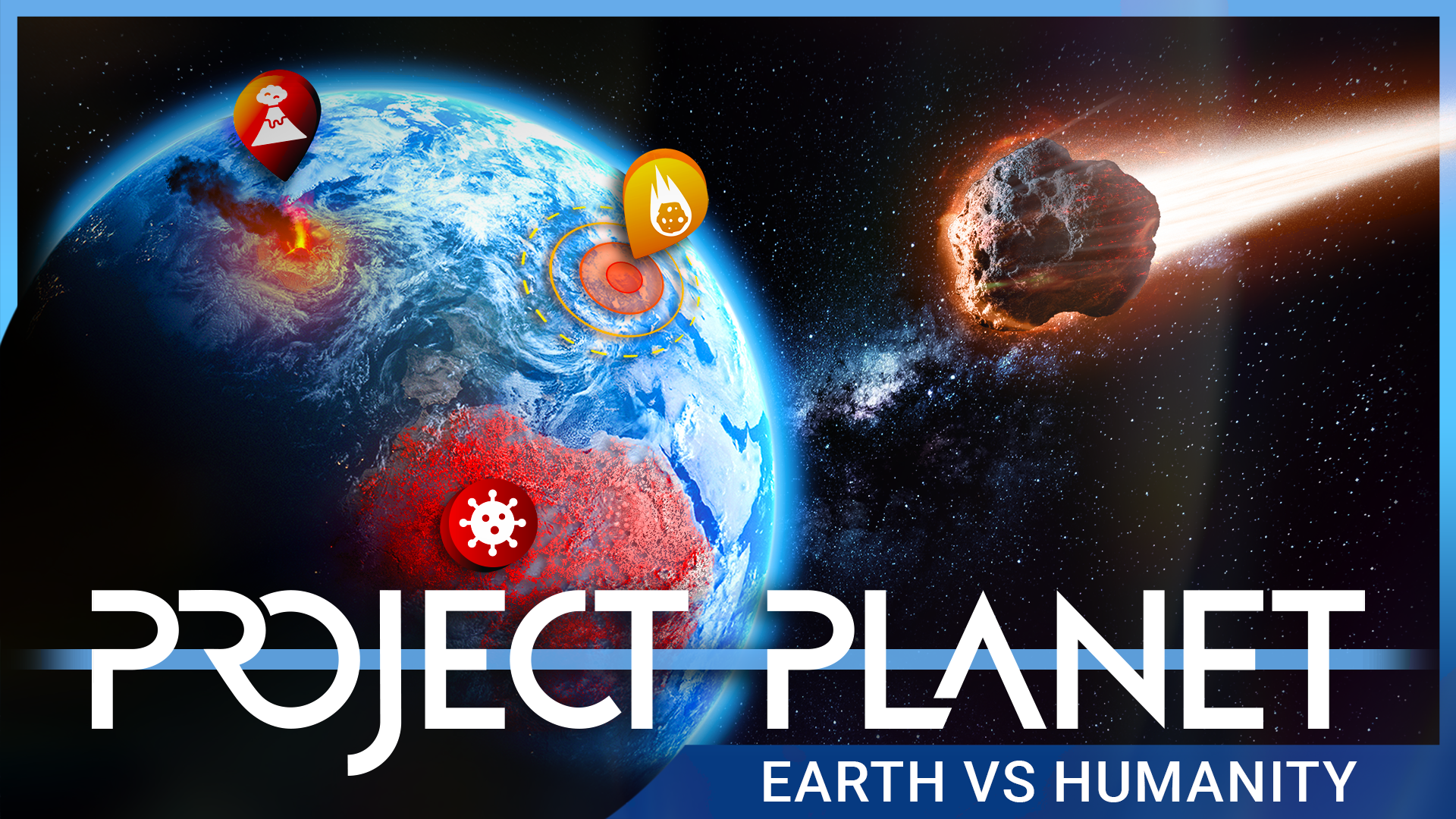
Project Planet—Earth vs. Humanity by Fifth Harbour Studios is a unique experience. What if Plague Inc. was a 1v5 game with a Jackbox Party Pack browser-based interface? What if it was an asymmetrical multiplayer game with five competing roles? Touting itself as a party game, Project Planet seeks to answer those hypothetical questions.
As the name suggests, the game has the pillars of humanity seeking to prevent the Earth from reclaiming itself. However, the catch is that there can only be one winner. Each player must balance cooperation and competition, lest the player controlling the Earth win. This makes an intriguing playstyle of game politics and strategy.
After playing several games with five other friends live on Twitch and a handful by myself, I have much to say about Project Planet. If you want to watch the 4 hours of footage, check out the VOD using the link here. Does Project Planet live up to the expectations it sets out? The short answer is yes, but I think there is room for improvement. Let’s get right into it!
Teeth-Clenched Teamwork
When taking on the role of humanity, players are split into five groups: World Leaders, Industry, Scientists, the Media, and the Public. Each role has individual options for what they can do in each game. After the Earth takes its first turn by choosing what initial catastrophe it wants to cause, the Media usually reports on it and sets the tone. On a side note, the news reports range from surreally funny to genuinely creepy. They are certainly a highlight of Project Planet. This news report from the locust plague scenario has been living in my head rent-free because of how funny and off-putting it is.

A gripe I have with humanity’s role is that, outside of the Media and the Scientists, who have a chance to reverse Earth’s effects, the others are harder to tell apart. Sure, they do have their place within a hierarchy and have unique interactions with each other. I wish that they had more of an identity. I do think it favors more aggressive players a little too much, as it is harder to win as the Scientists role because they have a built-in risk and reward system for solving the crisis not seen in the other roles.

Planet Terror
The Earth is a single-person role trying to wipe out humanity. Instead of playable roles, the Earth player selects which kind of apocalypse they want to bring—influenza virus, solar flare, hurricane, locust plague, or asteroid. Unlike humans, who get rewards for performing specific tasks, the Earth starts with points. These points are spent on a set number of abilities each cycle.

While Project Planet does not advertise itself as a horror game, its visuals and the premise perfectly capture a horror-style atmosphere. One of the game’s strengths is the planet’s visual effects. The solar flare and the influenza virus have stellar eye candy. The influenza virus is a lot like how Plague Inc. depicts its diseases, but the 3D visuals and the shades of red, pink, and magenta make it stand out. The solar flare and the asteroid both have a sense of looming danger. I wish, or hope, that the other two disasters will get more visual flair as these three do.
I think Project Planet, perhaps more than any other “virus simulator” type of game, really sells these games’ depressing and apocalyptic vibe. For the first few games, commenters in the Twitch chat expressed how genuinely unsettling it was to watch a rock slowly collide in the middle of Europe. That, coupled with watching the human population slowly decrease by thousands or even millions at a time, is delightfully unsettling.

Project Planet’s Presentation Problems
You might have noticed that I have talked a lot about the overall presentation, and there’s a good reason. I think the way Project Planet presents itself is the game’s greatest strength and its biggest fault. Don’t get me wrong; the game is a lot of fun. However, I had some gripes with the game feedback and its presentation to the players.
I mentioned that I streamed this game not just to plug it into the review, but it does provide an example of what I mean. For the footage, I captured the “master screen,” or the actual game window. I saved showing what the browser menus looked like until now because, as you can see, there is quite a lot to choose from. This would be fine in a room or over Discord, but I feel there isn’t much in the way of being presentable to a live-streaming audience. I also think the option of being able to see the hard data for some of the effects would be nice to have. It would help in making decisions, and also to find issues in game balancing. As it stands, just seeing arrows for how it would affect the population or pollution/ecosystems can be a little unhelpful.

To continue with visual feedback, it is also harder to play against AI. Don’t get me wrong; I am glad the option to have AI bots is here. It makes for good practice rounds, and it’s nice not to have a full lobby when dropping a few players. However, since Project Planet is about game politics, it can be harder to rely on them to make mistakes.
Final Thoughts
Project Planet is a highly ambitious project. I do fear that there are times when this review may come off as negative, but it’s because I’m excited to see more from it and the studio! I enjoyed my time with Project Planet, and my friends also want to play more of it. It has a few kinks here and there, but it excites me to see some of them addressed or what the next game from Harbour Studios will entail. If the price seems right for you and you are a Jackbox and Plague Inc. fan, consider Project Planet for your next game night.
Project Planet – Earth vs Humanity was fully released on Steam on September 25, 2023. The game retails for $24.99. PC Key was generously provided to Nevermore Niche by Fifth Harbour Studios.
Leave a Reply