
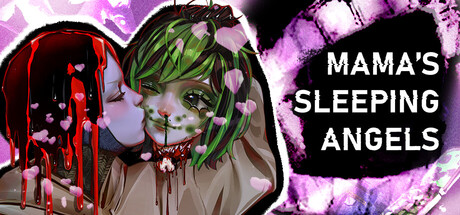
Somewhere between falling asleep at a sleepover and being devoured by an eternally hungry goddess, you will find a yellow squeaky toy that functions as a weapon, and that is the least weird thing you’ll find in this game.
Mama’s Sleeping Angels is a co-op horror-exploration game from solo developer itamu, published by Oro Interactive. A project that survived a failed Kickstarter campaign in 2024 to release on Steam in March 2026 — and arrived, against all odds, mostly intact.
You and up to three friends are trapped inside the dreams of Mama, with only two options- get out, or not. What follows is one of the more genuinely strange games I’ve played in the post-Phasmophobia co-op horror craze in the last half decade. Not strange in the way that reaches for strangeness. Strange in the way that seems completely unbothered by your confusion and moves on without you if you take too long figuring it out. A kaleidoscopic dreamcore-inspired acid trip that I am here for.
Lights Out, Go to Sleep
The setup is straightforward enough. You and your friends fall asleep at a sleepover and wake up somewhere considerably worse, trapped inside the dreams of Mama, an eternal goddess with an appetite for cursed objects and a habit of keeping sleeping children right where she wants them (huh… that’s… maybe I should rephrase—)

The price of leaving is straightforward, however. Collect enough of what she wants. Bring it back. She lets you go.
Simple. Right?
Mama’s dreams take the form of six distinct dreamworlds, procedurally generated locations that range from suburban streets to underground industrial complexes. Each with their own layout, atmosphere, and rotating cast of things that would very much like to kill you. Your primary objective across all of them is finding and returning cursed objects with weird effects.
Your main tool for understanding those objects is your early 2000s flip-phone. Pointing it at a cursed item lets you analyze and document it, feeding into an ongoing catalogue stored in the computer room back at the hub. It is a small thing, but it gives the experience a satisfying sense of building something between runs rather than just repeating them.
Now, alongside the standard quota-as-objective gameloop sits a second objective that is by far the more interesting one. Scattered across each map are Dream Friends, imaginary companions trapped in Mama’s eternal sleep. Finding them, collecting their masks, and waking them up rewards you with run bonuses that permanently alter your capabilities alongside lore fragments that piece together why exactly Mama has you here in the first place. There are twelve of them in total, and finding them all leads somewhere: an actual ending!
I know! For a co-op horror funny game? Crazy.

Combat arrives just as fast and without much warning. Weapons range from sniper rifles and chainsaws to things considerably less conventional (a yellow squeaky toy being perhaps the most famous example). Enemy encounters are built around unpredictability rather than pattern recognition. Spawns catch you mid-thought. Threat escalates faster than you expect. The game has very little interest in letting you feel settled.
Despite the predictability of the loop and the issues of the game, which I will expand upon soon, there is one thing Mama’s Sleeping Angels does impeccably well: Art Direction.
A Beautiful Dream-Sequence
There is a specific feeling that Mama’s Sleeping Angels chases visually, and it is a difficult one to articulate without just pointing at it. The closest I can get is this: everything in the game is familiar enough that you understand what you are looking at and overstimulating enough that understanding does not actually help you.


Take the suburbs map. Somewhere in it sits a public playground. There are slides, ladders, a climbing frame. You see it and your brain files it immediately under “playground.” And then you look closer. Floating platforms at wrong heights. Tunnels that wind into each other with no logical exit. Ladders leading to nothing in particular. The structure makes sense as a concept and no sense whatsoever as an object. That gap, between recognizing something and being able to process it, is where the entire visual identity of this game lives.
It is a specific blend of influences that should not work as well as it does. Neo-brutalist maximalism sits alongside Y2K futurism, sits alongside dreamcore liminality, sits alongside a PS1 polygonal junkiness that makes every surface feel slightly wrong to look at directly. The result is a game that radiates visual noise at a frequency just high enough to keep you permanently slightly unsettled. Giant floating heads. Massive Ferris wheels. A barn filled with pigs on guillotines, flying over spike pits, surrounded by walls of laughing dog heads. Described plainly, none of it sounds like it should work. Playing it, it coheres completely, because the incoherence is the point.
Even the hub communicates this. One wall is covered in propaganda magazine imagery, picked apart and stretched across the surface in a way that makes each image technically recognizable and deeply wrong simultaneously. It is overstimulation used as atmosphere, and as a tonal foundation for the game it is extraordinarily effective.

The presentation score of 4.5 out of 5 is the highest in this review, and it is earned. In a genre that has become overbearingly crowded, Mama’s Sleeping Angels has a visual identity that is immediately and unmistakably its own. That is not a small thing.
It does, however, come with a cost.
Back to the HUD
The same design philosophy that makes the world so visually compelling is applied with equal commitment to the HUD. That is where things get complicated. Your health is communicated through a heartbeat indicator. The faster it pulses, the closer you are to death. It is a genuinely interesting idea. The game never quite makes it legible enough to trust under pressure. After ten hours of play I still found myself glancing at it mid-run. I came away with a rough approximation rather than a clear read. The phone and terminal display lean into the same aesthetic language. Deliberately cryptic. Slightly garbled. It works as objects in the world. It fights against the moment-to-moment readability the game actually needs.

The tutorial gestures at all of this without really explaining it. You get enough to start, not enough to feel confident, and the game moves on before you have fully caught up. For a player who finds the aesthetic immediately infectious, that friction is manageable. For a player who needs clarity to feel in control, it is going to be a consistent low-level headache.
This is not a failure of vision. It is a failure of application. The aesthetic commitment that makes Mama’s Sleeping Angels visually remarkable is the same commitment that makes its interface actively work against you. The dream logic that sells the world is the same logic that obscures your health bar. Same instinct. Different consequences depending on where it lands.
That being said, I think it works in 95% of situations, but could use some polish to really fine-tune some of those more essential elements that would make the game more accessible to more players.
Reoccurring Nightmares
Mama’s Sleeping Angels has a lot of moving parts. The question is not whether they work. Most of them do, at least on first contact. The question is whether they hold up once the dream stops feeling new.
Dream Friends are the best idea in Mama’s Sleeping Angels, and it is not particularly close. Each one has a personality, dialogue, a reason to exist beyond being a collectible. Finding one feels like a small event rather than ticking a box. The fact that finding all twelve leads to an actual ending gives the entire loop a forward momentum that most games in this space simply do not bother with.

What they leave behind is where things get more complicated. The masks are a good concept that the game does not develop far enough. The passive buffs they provide over the course of the run are goofy, fun, occasionally genuinely useful. The problem is the pool is too shallow. Across fifteen hours and roughly fifty runs I encountered maybe ten distinct masks in total, and several of those are situationally useless depending on how you play. The teammate healing mask does precisely nothing in a solo run.
For the effort finding a Dream Friend actually requires, that payoff does not match. Cursed items have the same issue from a different angle. The variety is there on paper, the range of effects broad enough to be interesting, but the balance between useful and catastrophic tips too far toward random rather than meaningful. You take your chances and you live with the result, which is fine until it stops being novel. I can’t tell you the number of times I get bug swarm curse (which spawns a bug swarm in your vicinity at all times) and dropped the curse because the tradeoff in quota is not worth the headache. It’s a recurring issue.
This Dream Feels Familiar
That shallowness extends beyond the mask pool itself. The procedural generation is where the repetition becomes hardest to ignore. Layouts change between runs, yes, but the level itself does not. The suburbs map will always have five houses, one always flooded, one always empty. The Dream Friend at the top of the playset is always the same one. The tower always has the same friend, the same weapons, the same cursed items at the top. The generation shuffles the furniture without changing the room, and after a handful of runs the room feels very familiar. I spent entire runs climbing pre-generated structures expecting something meaningful and finding a mask I already had. The generation leans on layout variety to create the illusion of a different experience each time, and that illusion wears thin faster than the game can compensate for.

The generation is the most visible symptom. It is not the only one. The smaller systems round out a picture of a game with a lot of moving parts. Not all of them justify their presence. Item carry-over resets completely between runs. No inter-run economy, no accumulating advantage outside of masks, no reason to stay in a level beyond the minimum quota. The death system is a good example. You temporarily become a rolling head before becoming a ghost. It sounds interesting. In practice it just delays the inevitable without adding anything worth the delay.
Fighting enemies rewards you with nothing, a strange choice for a game that hands you weapons as generously as this one does. Ally healing almost never comes up because by the time you need it, you are already dead. None of these are catastrophic individually. Collectively they describe a game that keeps reaching for depth and stopping just short of finding it.
None of this makes the game bad at what it does. The loop is fun, the concept is strong, and the forward momentum of the Dream Friends objective does real work in keeping runs feeling purposeful. But there is a version of this game with twice the masks, a generation system that changes more than the furniture, and systems that argue clearly for why they exist. That version would be considerably harder to put down than what was given.
How much of that was limitation, I’m unsure, and I hope with time these improvements could be made because I do really like the game. However, just because I really like a game, doesn’t mean I can ignore critical flaws it has.
Kissing Friends at the Slumber Party
There is not a lot of mystery here. Mama’s Sleeping Angels is better with friends. Most games of this nature are, and this one is no exception.
What co-op specifically adds is worth unpacking beyond the obvious. The mask system becomes meaningfully more interesting when you have to decide who gets the one mask a Dream Friend drops and when. The built-in radio functionality on the phones means communication requires no setup, no separate item slot, no additional cost per run. It is just there, which sounds minor until you realize how many games in this space handle it worse. Enemy density scales up with additional players, which simultaneously makes the game harder and more manageable, the chaos better distributed across people who can actually respond to it. Solo, a bad spawn can end a run before you have time to react, but with friends, that same spawn becomes a story you tell afterward.

The game does expose some small gaps under co-op scrutiny. Only one player starts with a weapon by default, which at higher difficulties creates an early imbalance that feels more like an oversight than a design choice. The lack of a formal lobby system is a minor friction point that becomes more noticeable the more people you are trying to coordinate. And there is an unintended revival exploit near the end of runs that lets a freshly revived player sprint out, grab one more cursed item, and return in the last few seconds. Almost certainly not intended, and genuinely hilarious every single time.
Mama’s Sleeping Angels does not transform into a different game with friends. It transforms into a better version of the same one. For a game this chaotic and this visually overwhelming, that company makes a real difference.

A Good Dream That Ends Too Soon
Mama’s Sleeping Angels is one of my favorite games of the year so far. I want to be clear about that before anything else. The hours I put in were not endured, they were enjoyed, and I will be going back.
I also want to be clear that enjoying something and thinking it is great are not the same thing.
What has been built here is a game that understands its own aesthetic identity. Better than almost anything else in its space. The visual language is singular. The tonal commitment is total. For a certain kind of player, it is going to hit exactly right. The kind who finds something deeply satisfying about a maximalist dreamcore nightmare blender of a video game. It hit exactly right for me. I am not going to pretend otherwise.
But stripped down past the aesthetic, past the vibes, what remains is a game that gets repetitive faster than it should. The systems do not develop enough. The generation does not change enough. The depth that would make the loop genuinely sustainable is not quite there yet. That gap between how much I love the concept and how much the execution delivers is real. I would be doing nobody any favors by glossing over it.
The bones of a great game are here. The Dream Friends concept alone suggests a developer who wants to push past the genre’s usual limitations. The aesthetic is not accidental. It is the product of a specific and confident creative vision. What the game needs now is time. Updates. The kind of systemic depth that turns a game you enjoy into a game you cannot put down.
I hope this review lands somewhere useful, the praise and the criticism equal. I genuinely want to see this get better. It is already good enough that better would be something special. I also hope it finds more players who discover the same enjoyment I did. A few convinced people could benefit its momentum a great deal.
For now though, it is time to wake up.
Mama’s Sleeping Angels is a game created by itamu, published by Oro Interactive. It was released on Steam on March 11th, 2026.
Game was played and reviewed on Fedora KDE Linux.
Leave a Reply