
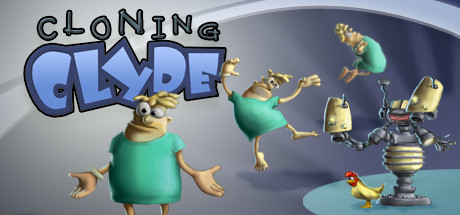
Cloning Clyde
Pros
Easy to pick up and play
Unique transformations with different abilities
Ability to choose and switch control to any Clyde in the level at any time
Toggle-able Extras unlocked for earning achievements and collecting items in levels
Cons
Graphics are a little simplistic
Enemies do not change – the only existing ones are security robots that spawn the same exploding mutants
Change in difficulty is merely amount of health Clyde has
The Future is Now
Few things make me feel my age more than knowing the XBOX 360 is over 20 years old, as well as the XBOX Live Arcade. Dozens of games—what would go on to be hundreds—all available without the need of a CD, was a novel concept. While there’s been some backlash to the idea in recent times thanks to the implementations of subscriptions and microtransactions, this problem did not yet exist in the open reign of the mid-2000’s consoles. Instead, many XBLA games at the time were given free demos to play and experience, with an option to purchase the full game if you liked it enough.
Enter Cloning Clyde, developed by NinjaBee (the self-funded division of Wahoo Studios, Inc.) in association with J. Kenworthy Entertainment (later rebranded as Bacon Wrapped Games,) and published by Microsoft Studios. Originally released on July 19, 2006, for the XBOX Live Arcade, it was later ported to Steam on March 15, 2011. In November 2021, it made backwards compatible on XBOX One and XBOX Series X|S, a couple years before XBLA was discontinued. John Kenworthy Nielson would later move on to work at Disney and spend ten years with Epic Games, while NinjaBee continued to produce new content, such as A Kingdom for Keflings on the XBLA, and its sequel, A World of Keflings, which eventually got a Steam port.
The Gowned Clown of Lockdown
Meet Clyde. Just like the Pac-Man ghost who shares his name, he’s not the brightest. His enthusiasm for martial arts is apparent, even if his knowledge of it is more dubious1. He keeps a Killer Ken action figure in his back pocket at all times (even when his outfit doesn’t have pockets… or a back.) But most importantly, he needs money, and when a scientist gets his attention and offers him twenty dollars to take part in a research experiment, he takes it in an instant. What’s the worst that could happen?
As it turns out, the scientist works at a cloning facility, and Clyde took twenty bucks in exchange for his consent to be cloned. Something goes wrong during the test though, and Clyde keeps cloning, and cloning, and cloning… With the facility going into lockdown, Clyde and the clones (at least 263, but if we’re going by the game’s exposition, the number’s in the 2-3 thousand range) need to work together to bust their way out.

Laboratory or Labyrinth?
Escaping the facility isn’t as easy as finding an exit door. Each level has a certain amount of security robots, who defend themselves by firing… exploding mutant chickens? That are capable of friendly fire? Destroying one of these machines triggers an internal ‘check’ in the game linked to another element, such as opening a gate, spawning the level exit, or unhooking a crate to drop a couple more Clydes into the level. Destroying all the security robots in a level will open emergency slides, which allow Clydes to crawl into and escape the lab. This is merely optional though, and one Clyde (or two if you’re playing multiplayer) must always be left for the player(s) to control and bring to the teleporter that functions as the main exit.
Levels come in a variety of aesthetics: Workplace/cubicle, tiki/rainforest, marshy/swamp, farmland/countryside, snowy, and desert. There is one Tutorial level, four demo levels for people playing the free trial, 25 story levels unlocked in four-level increments, and 10 challenge levels unlocked in two-level increments whilst clearing the story levels. That’s a total of 45 levels, with each of them containing Clydes to save, Killer Ken action figures to collect, and a “Par time” to clear as fast as possible. These bonus objectives are shown at the level doorway portal and when exiting said level, so you know what still needs to be done. Clearing enough of these bonus objectives will give you cosmetic extras that can be toggled on and off in the pause menu (though getting 100% provides a bragging-rights extra that actually provides gameplay changes; I won’t spoil anything more than that!)

“Are You Thinking What I’m Thinking?”
Due to the number of platforms and puzzles, Clyde and his clones are not controlled simultaneously; rather, the player controls one (or two in multiplayer) with your name/gamertag appearing below the one you are in control of. Another button is used to enter “Clyde-Switcher Mode,” an astral projection of sorts where you get free roam of the camera and can hover over all the available Clydes in the level to take control of (the nearest selected one will glow to stand out from the others.) This allows you to maneuver a variety of Clydes across levels to press multiple switches, land on scales that require the weight of more than one person, and solve puzzles.
It also automatically triggers when you have a Clyde escape through an emergency slide, so you can select another one to continue (they are, however, allowed back into the level by pressing a button on the slide itself so you aren’t locked out of any puzzles after the exit has spawned.) Clyde-Switcher Mode’s free roam of the camera also shows a small minimap at the bottom of the screen, showing Clydes, interactable objects like health, and other helpful material, giving you a better look around to find that last missing secret.

BrundleClyde
Getting cloned several hundred/thousand times in a chaotic lab accident and being hunted in an escape attempt is going to leave someone changed down to their core, but Clyde sees this change a bit more literal than figurative. DNA-combination machines can be found through various levels, and placing a lab animal (or TNT barrel) on one side and Clyde on the other fuses them into a mishmash of the animal’s abilities and Clyde’s… well, lack of brains. Still, it’s enough to solve puzzles and escape otherwise-impossible situations, so there’s no harm (metaphorically, Clyde’s transformation sequence doesn’t look too pleasant for him) in making these fusions. What’s a living nightmare for one Clyde transformed into a half-rock hybrid when you have hundreds of backups?
Chicken Clyde: Gains a faster pecking attack. Repeated double-jumps allow for flight.

Sheep Clyde: Gains a strong hoof attack. Much faster running, and running jumps from the ground provide notable horizontal distance.

Frog Clyde: Can stay in water indefinitely and has additional mobility in it (chickens still sink like a stone though.) Possesses a very high single-jump and a standard double-jump.

Ape Clyde: Can swing from metal rafters to make it across large gaps.
(For the record, those are squished tiki statues he’s standing on, not burgers. Yes, he’s disappointed about it too.)

Barrel Clyde: Lets you breathe underwater at the cost of sinking like a brick. Harmlessly explode at a button press, with no limit as to how many times. Explosions can be used to destroy stone walls, trigger chain reactions, or obliterate security robots in seconds.

Second-Degree HomiClyde
Seeing as Clyde’s stupidity was one of the reasons he ended up in the lab mess in the first place, it’s only fair his stupidity helps him get out of it as well. Comic mischief is rampant in the game, from hobbling in pain after kicking a rock to getting sent flying by an activated catapult. Clyde’s hair can be lit up by a torch, which can then be brought to a rocket, lighting the fuse, and depending on where the firestarter stands, can be carried along for the ride until the rocket explodes, leaving Clyde unharmed. Lab animals like apes, frogs, and especially sheep and chickens can also get in on this mischief, at most having their fur/feathers blown off by mines or bombs, but otherwise left completely invincible and no worse for wear (PETA still probably wouldn’t be a fan though.)
It’s not just the player who gets a laugh out of the madness either—Clyde can send clones (or another player) flying with a kick, pick them up and chuck them off cliffs, launch them with the explosions of a TNT barrel, or bonk them on the head with a rock. Other clones who watch the mischief are viable to point and laugh (though self-schadenfreude must be some serious psychological debate.) Overall, Clyde takes the hits in stride, and it’s clear that nothing, not even himself, will stop him from escaping the lab. Just remember, no animals were harmed in the making of this game!

In Conclusion
It’s hard for a game not to age in 20 years, and while Cloning Clyde unfortunately isn’t an exception, it’s still worth a couple hours of simple puzzles and platforming. The ‘check’ concept for levers, buttons, and Security Robots affecting objects throughout a level are simple to understand once you look at it, and I feel like it would make for a phenomenal level editor for a community to create their own ideas. Assuming the crude humor of hospital gowns and 2000’s treatment of lab animals isn’t a problem, it’s a good game for families or younger players, and this being the first game I ever got every achievement in all those years ago, it might be fun for nostalgic collectors or those wanting their first taste at that 100% glory.
More platformer games covered on NeverMore Niche can be viewed here, more puzzle games can be viewed here, and more multiplayer games can be viewed here.
Additional Screenshots


- Clyde’s standard attack without any transformations appears to be a Ushiro Geri back kick. One of the signs from a “Karate Clyde” clone points out his “karate ninja skills” as a self-defense tactic. Two of Clyde’s lines when attacking are “Yes, Sensei” (a Japanese honorific/title used by mentors) and “Peking duck” (a dish sourced from and commonly associated with China.) While these mixes of Chinese and Japanese concepts could be Clyde being ignorant, Karate does actually take some inspiration from 14th century Chinese martial artists bringing their techniques to Okinawa. In fact, this mix of Chinese and local martial arts would become known as kara-te (唐手), which translates to “Chinese hand.” Ninjas never used it though, as they had their own martial art known as Ninjutsu. ↩︎
Leave a Reply