
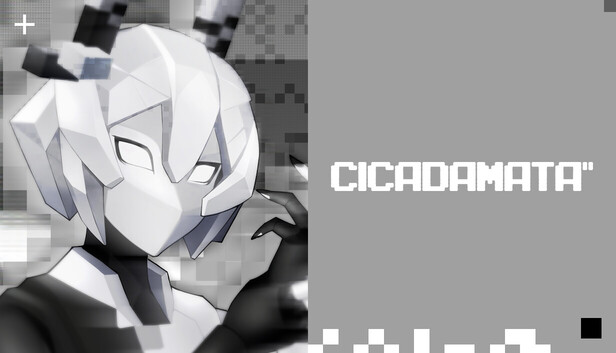
CICADAMATA"
Pros
Excellent Gameplay Feel
Addictive Style
Fast-Paced
Good Pricing
Cons
Inconsistent Level Quality
Underbaked Worldbuilding
Accessibility Issues
“You have been enlisted as a CICADA. This is who you are now. Tear flesh from bone.”
CICADAMATA” is a fast-paced first-person [?platformer, %shooter, $speedrunner], by its own description; developed and published by ✿ flowergarden. It released on Steam August 21st, 2026 and has been drawing eyes from the speed-runner-perfectionist indie space since.
You play as FAWN-A2, a CICADA, deployed to retrieve cores for people who… never really explain why. That means eighteen-ish levels spread across six “spheres,” and it means running, jumping, sliding and shooting through them fast enough to place on a global leaderboard that is very happy to remind you how bad you are at this game. I am, for the record, bad at this game.
It’s fast. It’s loud. It feels fantastic…
…and the least legible game I have played this year, but we’ll get there.
?Distinction : > White Rabbit
You are a CICADA; FAWN-A2, Distinction: White Rabbit.
You are being deployed into CASCADE under a core retrieval protocol, your obligations no longer bind you, and you should disconnect and go. It does not tell you who is speaking. It does not tell you what a CICADA is, what CASCADE is, what the cores do, or who wants them. You get a designation and a job, so you had better damn well do it.
Nothing gates you, nothing checks your work. You jump, you slide, you learn how far you carry and how hard you stop, and somewhere in there a weapon ends up in your hands and the training wheels come off without ceremony.
And then you go. Pedal to the metal.
The loop is four cores a level, surfacing on your HUD once you are close enough, then a retrieval point that is sometimes where you started and sometimes nowhere near it. Kill what’s in the way. Don’t die. Leave … then do that eighteen-ish times across six spheres and you are well and done finished; or you would be, if you did not want to master it and climb the board.
Which is the actual game. You clear a level, see where you land among the thousands who came before you, notice you are 500 points off Gold Tier, and run it again, and again, until you get bored and move to the next one.

And that’s the pattern everywhere. CICADAMATA” is extremely good at telling you what to do and almost completely uninterested in telling you what any of it means. You are a weapon. You were told to go. That is the whole of your relationship with this world, and for a game whose stated goal is to make you become one with joyeuse (the weapon..? I think) until you are no longer you, the withholding reads as deliberate. The erasure is the point.
At least, that’s the pitch.
+ digital {WONDERLAND} +
Staying sold on that pitch is the harder part, and it comes down to one unflinching choice in visual design. Which is a shame, because the look itself is one of the best things this game has.
Everything is geometric, hard-edged, built out of blocks that feel less constructed than rendered. It’s the visual language of a hacking minigame. Except instead of routing data, you’re moving at Mach 5 and shooting things. Each of the six spheres gets its own palette of cookie-cutter geometry. That does more work than it sounds like it should. You learn where you are by what color the floor is. Which becomes especially relevant once the levels start mixing.

It is a good look. It is also, I’d say, a fairly stock one; blocky digital abstraction is well-trodden ground, and CICADAMATA” walks it confidently rather than doing anything new with it.
Enemy design is where it gets loose. Weird life-sucking magic-kinda dudes, giant red crabs, spiders that drop from the ceiling (when there are ceilings), flowers that explode. Nothing connects any of them to anything else, and it lands as goofy rather than as chaos the game has earned. It did not ruin the vibe; it just never quite joined it.
But the UI leans into this style too, and it has a major issue, which leads me to warn: if you are photosensitive, I do not recommend this game. The game echoes that in its own startup warning. Steam’s store page does not, which seems like the wrong place to leave it out.
Kills play an animation. Firing plays a different one. Glitch effects layered over both, and a UI running at roughly 200% of what it needs to be. You can turn some of it off (screen shake, a portion of the flashing) and I tested with all of it off; it helps, but nowhere near enough. Turning noise down is not the same as the noise not being there, and there were long stretches where I could not tell what I was looking at. I will grant that you probably acclimate, that it eventually becomes second nature to look at and stops distracting you. But it is weirdly, insistently over-the-top, and for whole levels at a time the UI pulled me into confusion rather than into the experience.
Which is frustrating, because the art direction really is great. It just has no more legible version of itself to fall back on.
#6.00 {Spheres/Shapes]
Unfortunately, the mixed results continue with the game’s progression, which lives in the spheres. Six of them, each presented as its own chunk of the game, each supposedly a real departure from the last.
They mostly aren’t. The gameplay sharpens as you go, and the environments do change; that palette shift is doing real work. But strip that away and a sphere is a place you start and a place you end, with no mechanic that belongs to it alone and no rule that only applies in sphere group A or B. The game tells you you’ve crossed somewhere new, then hands you more of the same, slightly harder.
What saves it is that the levels themselves are often very good. There is a descent in one of the early spheres that mimics a ski slope, or a set of slides, and it is the best this game ever feels: you commit, you carry speed the entire way down, and the level gets out of your way and lets you be fast.

And then there are the ones that are not that. The later levels start reaching for complexity and trip over it, stacking verticality and mixed geometry until the level stops being hard and starts being unclear. The ideas underneath are fun, but a confusing level and a demanding level are not the same thing, and too many of these land on the later.
That inconsistency runs the whole way through, which is a real problem. It is not that the back half is weak and the front half is strong; it is that any given level could be either, and you do not know which until you are inside it. For a game built on repetition, on running the same level until the time comes down, that matters more than it would anywhere else. You will happily re-run a great level fifteen times; you will not re-run a confusing more than once or twice before frustration sets in.
What Is a ?CICADA
I said the erasure of meaning in CICADAMATA” was the point. I want to walk that back a little.
There is lore here. Not a story (the distinction matters) but lore: a setting, a pitch, an idea about what CASCADE is and what a CICADA is for, and it’s an interesting one. I’m not going to recap it for you. Partly because that’s yours to find, and partly because the game isn’t especially interested in handing it over either.
What you get is a handful of fragments on the way in and a handful more on the way out. For most of the eighteen levels there’s nothing at all. You’re a designation with a job, which that was the pitch, and for a long stretch it works exactly as intended.
And then the ending arrives and the game changes its mind.

There’s an entire visual-novel-style sequence near the end, and it’s clearly meant to be the payoff: the moment the withholding pays out and you find out what you’ve been doing and what it cost. It’s reaching for something real, but it’s reaching for the top of a staircase the game never built. Nothing in those eighteen levels sets it up. It arrives, asks you to feel the weight of information you were deliberately denied, and ends.
For me that’s what drops this hardest. Withholding is a choice I respect, and plenty of games make it work by letting the absence be the answer. This one withholds and then wants credit for the reveal anyway, and you can’t have both. Either the erasure is the point, or it was setup. This lands in the gap between them, where the silence reads as nothing happening rather than as something being kept from you.
I can digress in admitting that, perhaps, in my 15-ish hours of play, I had missed some of the buildup in these levels for that conclusion. But I find it hard to use that as an argument in the case of me having constantly re-played the levels over and over in the need for “perfection” of score.
It’s a game with lore, but it isn’t a game that knows how to communicate it.
> Synthesis
Here’s the thing I keep coming back to: when this game is working, almost none of the above matters.
The movement is excellent. Not novel (you have jumped and slid in a first-person game before) but tuned with real care. Momentum carries the way you expect and stops the way you expect. Slides chain into jumps without fighting you. The weapon lands with enough weight to read as punctuation rather than as an interruption. Four cores, a clean line between them, an exit you can see from halfway across the level: when the level is good and the UI calms down for a second, the whole thing collapses into one uninterrupted motion, and that is worth ten dollars on its own.
Which is exactly why the inconsistency stings. The pieces are better than the thing they add up to.
And it runs. CICADAMATA” lists Windows only on Steam, with no SteamOS support and no Deck rating, and I played the whole thing on Fedora under Hyprland through Proton without touching a single launch option. No crashes, no stutter worth naming, and the frame rate pinned exactly where I set it. Wayland didn’t fight it, which, if you run Hyprland, you know is a sentence that rarely gets written.
The game’s problem isn’t that it’s broken; it’s that it isn’t finished thinking.

The Start, the End, the [$Flesh/?Meaning]
Tear flesh from bone.
It’s the first thing the game says to you, and it’s a good line: violent, certain, with no room in it for a question. It tells you exactly what you are. The whole game really makes you believe it. You move beautifully, you kill efficiently, you post a time, you go again. For long stretches it works. You stop asking what a CICADA is and simply become one, which I think is the actual design goal, and when the level is good and the screen is behaving, CICADAMATA” pulls it off as well as anything I’ve played this year.
The trouble is that it wants the other thing too. It wants the ending to land, and it wants you to have been a person this whole time so that losing that registers as a loss, but it never did the work to make you feel that way.
So what you’re left with is a game of excellent parts that doesn’t resolve. The movement is great; the art direction is great and then actively hostile; the levels are superb and then baffling, with no way to predict which; the lore is interesting and almost entirely untold. At $9.99 it’s still an easy recommendation for anyone who wants to run the same thirty seconds forty times until it’s perfect, because there is well over ten dollars of good game in here, and the speedrunning crowd it’s found is the right crowd for it.
But I said at the top that it’s the least legible game I’ve played this year, and I meant that in more ways than the UI. It never decided what it wanted you to understand.
Game was played and reviewed on Fedora Hyprland Linux.
Leave a Reply